Artificial Intelligence (AI): A Complete Guide to Definition, Examples, and Top Universities
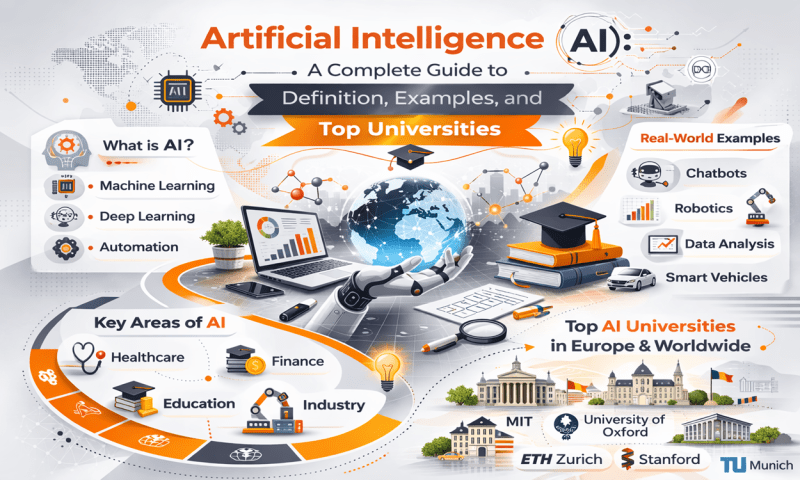
Artificial Intelligence (AI) is transforming industries worldwide, from healthcare and finance to robotics and data science. This blog provides a complete guide to Artificial Intelligence, covering its definition, real-world examples, applications, career opportunities, and top universities offering AI programs. Learn how AI works, why it’s one of the most in-demand fields today, and where to study AI to build a successful global career.
Table Of Contents
Artificial Intelligence (AI): A Complete Guide to Definition, Examples, and Top Universities
Artificial Intelligence (AI) explained with definition, examples, career scope, and top universities offering AI programs worldwide
Keywords: Artificial Intelligence complete guide, AI definition and examples, study Artificial Intelligence, AI courses and universities, top universities for AI, career in Artificial Intelligence, AI programs abroad, machine learning and AI degree
Artificial Intelligence (AI) is one of the most transformative technologies of our time. Across industries—from healthcare to finance, from entertainment to transportation—AI is driving innovation, enabling new products, services, and ways of living. But what exactly is AI? How is it classified? What are its real-world examples? And if you want to build a career or do research in AI, which universities are leading the field?
What is Artificial Intelligence?
Artificial Intelligence refers to the field of computer science and allied disciplines focused on creating machines or software that can perform tasks which normally require human intelligence. These tasks include reasoning, learning, perception, language understanding, decision making, etc.
Some key elements often included in formal definitions:
- Learning: the ability to acquire new knowledge or improve performance based on experience.
- Reasoning: drawing inferences, making judgments under uncertainty.
- Problem-solving: breaking down complex tasks into manageable sub-tasks and executing solutions.
- Perception: interpreting sensory inputs (like images, sound) into meaningful information.
- Language processing: understanding and generating human languages (e.g., speech, text).
- Autonomy: carrying out tasks without continuous human oversight.
AI is not one fixed thing; rather, it is a spectrum, with systems being more or less capable, more or less general in what they can do.
There are some related concepts to distinguish
- Machine Learning (ML): a subset of AI focusing on algorithms that improve with experience/data.
- Deep Learning (DL): a further subset, using neural networks with many layers.
- Symbolic / Classical AI: older paradigms using rules, logic, expert systems.
AI systems tend to be evaluated in terms of their capability, generalization, efficiency, accuracy, adaptability, and also increasingly in terms of ethics, fairness, interpretability, safety, etc. At its core, AI tries to emulate or simulate aspects of human cognitive functions via machines or algorithms. There are many subfields in AI, but they all contribute to that broad goal.
What are the types and classifications of AI?
AI can be classified in different ways depending on what dimension you use—capabilities, memory, functionality, consciousness, etc. Here are some of the main classifications used in academia and industry.
A. Based on Capability / Generality
- Narrow AI (Weak AI)
- Systems designed to perform specific tasks, e.g., recognize faces, translate text, and recommend products.
- They do not possess general intelligence, i.e., cannot transfer learning or reasoning from one domain to another in a human-like way.
- General AI (Artificial General Intelligence, AGI)
- Hypothetical future AI that can understand, learn, adapt, and perform any intellectual task that a human being can.
- It would have flexibility, adaptability, and domain transfer (i.e., use knowledge learned in one area to help in others).
- Not yet achieved.
- Superintelligence (Artificial Super Intelligence, ASI)
- A level beyond AGI: AI that surpasses human intelligence in all respects—problem solving, creativity, social skills, etc.
- Entirely theoretical at present; associated with significant ethical, safety, and philosophical discussions.
B. Based on Functional / Behavioural Types
These relate to memory, awareness, decision horizons, etc.
- Reactive Machines
- These are the simplest forms of AI. They respond to inputs in the moment, without memory of past events.
- They do not store experiences to use later.
- Example: IBM’s Deep Blue (chess-playing computer) evaluates the board and makes moves, but doesn’t “remember” past games to inform future strategy.
- Limited Memory
- These systems can use past observations or short-term memory to inform decisions.
- Most current ML systems, especially those in domains like self-driving cars, speech recognition, etc., fall here: they use past data to predict or act in current/future settings.
- Theory of Mind
- A level of AI which (in theory) understands that other entities have beliefs, desires, intentions, etc.
- It would be able to model mental states of others, potentially understanding human emotions and social cues.
- Still highly research-oriented; not yet realized in full.
- Self-Aware AI
- The hypothetical highest level of AI consciousness: it would have awareness of its own mental states, self-identity, etc.
- Entirely speculative at this point.
C. Based on Method / Technique
Another way to classify AI is by how it is built or what paradigm it follows:
- Symbolic AI / Rule-based AI: early systems that use explicit logic, rules, and expert systems.
- Statistical AI / Machine Learning: systems that learn from data and infer patterns. This includes supervised, unsupervised, semi-supervised, and reinforcement learning.
- Deep Learning: multi-layer neural networks; convolutional neural networks (CNNs), recurrent neural networks (RNNs), and more recent architectures like transformers.
- Hybrid Systems: combining symbolic and neural/statistical approaches; combining domain knowledge and learning.
- Other paradigms: evolutionary algorithms, genetic programming, fuzzy logic, probabilistic graphical models, etc.
D. Other Classifications or Dimensions
- By modality/domain: computer vision, NLP, robotics, planning & control, speech recognition, etc.
- By application context: healthcare AI, autonomous vehicles, finance, entertainment, security, etc.
- By level of autonomy / human-involvement: fully automated, semi-automated, human-in-the-loop.
Real-World Examples of AI
To understand how AI is relevant and practical, here are several examples where AI is already being used or is emerging strongly. These illustrate different capabilities of AI in real settings-
A. Every day and Consumer Examples
- Virtual Assistants and Chatbots: Siri, Alexa, Google Assistant, ChatGPT, etc. They use natural language understanding, dialogue management, and text or speech generation.
- Recommendation Systems: Netflix, Amazon, Spotify, YouTube. Suggest items (movies, music, products) based on past behavior, preferences, collaborative filtering, content-based filtering, etc.
- Smartphones & Apps: Voice recognition, photography enhancements (e.g., automatic scene detection, image stabilization), predictive text, spam filters.
B. Health and Medicine
- Medical Imaging Diagnostics: AI systems analyzing medical imaging (X-rays, MRIs, CT scans) to detect tumors, fractures, and anomalies.
- Predictive Analytics for Disease Risk: Using patient data (genetics, lifestyle, history) to predict risk of diseases, or to recommend personalized treatment.
C. Autonomous Systems & Robotics
- Self-driving cars / autonomous vehicles: Using sensors (camera, lidar, radar), perception models, planning, and control systems to navigate.
- Robotics in Industry: Robots in warehouses for sorting and picking; drones for delivery; automated machines in manufacturing.
D. Generative AI
- Text generation / Language Models: GPT‐3, GPT-4 / ChatGPT, etc., which generate coherent text, answer questions, and translate languages.
- Image generation: Tools like DALL-E, Stable Diffusion, and Midjourney. Create images from text prompts or modify pictures.
- Other media generation: Music, video, voice cloning, etc.
E. AI in Infrastructure, Governance, and Environment-
- Climate / Environment Monitoring: Predicting weather events, flood forecasting, pollution monitoring.
- Smart Cities / IoT: Traffic management, energy optimization, waste management using sensor networks and AI.
- Security & Fraud Detection: Identifying fraudulent transactions, monitoring for cyber threats, and anomaly detection in network behaviour.
F. Recent Examples and Trends
- A systematic review of Generative AI shows how these models are being applied across image translation, medical diagnostics, textual imagery fusion, etc.
- In mobile applications, large empirical studies have shown increasing adoption of AI techniques—on-device ML/DL vs cloud-based, concerns around user privacy, framework usage etc.
These examples demonstrate that some AI tasks are narrow (specialized), others are more general; many systems combine multiple AI capabilities.
Which are the top universities for AI?
If you are considering studying AI whether at bachelor’s, master’s, or doctoral level—it helps enormously to pick a university with intense research, good faculty, good labs, and industry connections. Below are some of the top universities globally, with some information about what makes them stand out in AI.
A. Metrics to consider in ranking AI Universities
- Number of AI-related publications
- Citation impact (how often those papers are cited)
- Specialized AI / ML/robotics / NLP research groups/labs
- Courses/degree specializations in AI
- Compute resources, access to datasets, and collaboration with industry
- Interdisciplinary opportunities (ethics, policy, etc.)
- Admission standards, funding, and fellowships
B. Top Universities Globally
Here are some of the leading universities for studying AI, in no strict order, with their special strengths. Many of these recur in multiple ranking lists. Data is drawn from recent studies.
Leading Universities Worldwide
| University | Country | Why It’s Strong in AI |
| Massachusetts Institute of Technology (MIT) | USA | MIT has been a top contender in AI for many years. The MIT Computer Science & AI Laboratory (CSAIL) is among the most prestigious AI research labs. It supports wide ranging research: robotics, theories of intelligence, ML, systems, etc. |
| Carnegie Mellon University (CMU) | USA | CMU’s School of Computer Science is legendary for AI and robotics. CMU offers strong master’s and PhD programs, and research in autonomous systems, human-robot interaction, etc. |
| Stanford University | USA | Stanford's AI research is highly influential; the closeness to Silicon Valley provides opportunities for collaboration. Strong in NLP, autonomous systems, human-AI interaction. |
| University of California, Berkeley (UC Berkeley) | USA | Berkeley AI Research (BAIR) is a leading lab. Broad offerings in ML, reinforcement learning, fairness in AI, computer vision, etc. |
| University of Oxford | UK | Strong in both theoretical and applied AI, especially ML, ethics, robotics, computer vision, etc. |
| University of Cambridge | UK | Cambridge has strong reputational strength, good research groups especially in ML, AI safety, ethics, etc. |
| ETH Zurich | Switzerland | Excellent in robotics, machine learning, computer vision; well- funded and well connected. |
| National University of Singapore (NUS) | Singapore | Very strong AI/data science programs; research in smart city AI, ML, NLP, etc. High global ranking. |
| Tsinghua University | China | Ranked top in AI in many subject rankings; massive investments, strong faculty, especially in engineering and technology. |
| Mohamed bin Zayed University of Artificial Intelligence (MBZUAI) | UAE | A relatively new university focused solely on AI. Established in 2019, with graduate-level AI research programs; starting undergraduate in 2025. Good for students who want a focused AI-only environment. |
Additional Noteworthy Universities
These are also excellent, depending on your specialization, budget, and location preferences:
- Georgia Institute of Technology (Georgia Tech), University of Illinois, Urbana-Champaign (UIUC) in the USA
- Imperial College London in the UK
- University of Michigan, USA
- NTU (Nanyang Technological University), Singapore
- Universities in Europe, like TU Munich, EPFL, KU Leuven, University of Amsterdam, etc.
What You Can Expect in Terms of Programs?
Depending on the university, programs may offer:
- Bachelor’s degree in Computer Science with specialization options (AI, ML, robotics)
- Master’s / MSc in AI, ML, Data Science
- PhD / Research degrees focused on specific AI subfields (e.g., NLP, Computer Vision, Robotics, AI Ethics, Reinforcement Learning)
- Research labs, centers, summer internships, and collaboration with industry (big tech companies, startups)
- Access to high-performance compute (GPUs/TPUs), datasets, and open-source tools.
E. Admission, Cost, and Scholarships
- Admission into top AI programs is competitive: strong mathematics, programming background, good undergraduate record, often competitions (e.g., coding, ML), and research experience help.
- Costs vary significantly depending on the country and whether the institution is public or private. Be mindful of tuition, living costs, and funding—many PhD & some master’s programs offer assistantships, scholarships.
- For international students, visa & language requirements, and potential for sponsorship matter.
What should you look for when choosing a university for AI?
Since there are many good universities, selecting the right one depends on your goals, interests, and constraints. Here are some criteria to help you decide:
- Faculty / Research Strength: Are there professors whose research aligns with your interests (e.g., NLP, computer vision, robotics, AI safety)? Look at their publications, labs, and projects.
- Labs, Resources & Infrastructure: Having access to GPU/TPU clusters, robotics labs, data sets, etc., matters for practical AI work.
- Specialization Options: Some universities provide strong specialization tracks (e.g., for machine learning, robotics, vision, generative AI, ethics, and fairness), so pick ones that match your interests.
- Industry Connections & Internships: Universities located in tech hubs or those with strong partnerships can provide internship opportunities, mentorship, and exposure.
- Interdisciplinary Opportunities: AI touches many domains (psychology, neuroscience, ethics, law, health). If your interest crosses disciplines, choose a place that encourages that crossover.
- Ethics, Safety, Policy: As AI becomes pervasive, responsible AI, ethics, and policy are growing fields. Universities that provide coursework or research in those areas can give you a broader perspective.
- Cost, Scholarships, Location: Tuition, living cost, availability of funding (scholarships, assistantships), visa considerations, etc.
What are the challenges of AI?
Artificial Intelligence offers vast potential but faces various technical, ethical, social, and economic challenges that impact its responsible use and growth.
- Data Privacy and Security- AI depends on large datasets, making data privacy a primary concern. Sensitive information can be leaked or misused despite data protection laws like GDPR.
- Bias and Fairness- AI models can inherit human biases from datasets, resulting in unfair or discriminatory decisions, such as racial bias in facial recognition systems.
- Lack of Transparency (Black Box Problem)- Complex AI systems often make decisions that are difficult to interpret, reducing trust and accountability, especially in fields like healthcare and law.
- High Implementation Costs- Developing AI requires expensive infrastructure and expert talent, making it inaccessible for smaller organizations and developing nations.
- Job Displacement and Economic Impact- AI automation threatens traditional jobs, creating unemployment fears and the need for widespread reskilling.
- Ethical and Moral Concerns- AI lacks moral reasoning. In critical situations, like autonomous vehicles, decisions can lead to ethical dilemmas.
- Security Threats and Misuse- AI is vulnerable to misuse, such as deepfakes and cyberattacks, which can spread misinformation and cause social harm.
- Data Quality and Availability- Poor or outdated data reduces AI accuracy, as seen in flawed medical or predictive systems.
- Legal and Regulatory Challenges- The absence of unified global AI regulations creates confusion for international developers and users.
- Energy Consumption and Sustainability- AI models require immense computational power, leading to high energy consumption and environmental concerns.
- Integration and Compatibility Issues- Organizations often face difficulties merging AI systems with older technologies due to limited technical expertise.
- Lack of Skilled Professionals- There’s a global shortage of AI experts, creating competition and higher employment costs in the tech industry.
What is the Ethics and Future of AI?
Ethics of Artificial Intelligence (AI)
- Definition and Importance- Ethics in AI refers to the moral principles guiding the development, deployment, and use of AI systems. As AI becomes integral to healthcare, education, finance, and law, maintaining ethical standards is essential to ensure trust and fairness.
- Fairness and Bias- AI systems can reflect and amplify existing human biases present in training data. However, biased AI decisions can lead to discrimination and reinforce social inequalities. Although developers must use diverse datasets and transparent data practices to promote fairness and inclusivity.
- Accountability- Determining responsibility for AI errors is complex—should it lie with the programmer, the user, or the machine? Clear accountability frameworks are necessary to build trust and ensure responsible AI usage.
- Privacy and Data Protection- AI models rely on vast amounts of personal and sensitive data. Ethical AI must protect this data through encryption, anonymization, and adherence to data protection laws like GDPR.
- Autonomy and Consent- Users should have the right to know when they are interacting with AI systems. AI systems must respect individual autonomy and obtain informed consent regarding data use.
- Transparency and Explainability- AI operations should be understandable to users and stakeholders. In sensitive areas such as healthcare or criminal justice, explainability ensures accountability and builds confidence in AI decisions.
- Human Dignity and Social Welfare- AI should enhance, not replace, human intelligence and creativity. Ethical AI must uphold human dignity by serving society’s welfare, justice, and equality rather than exploitation.
- Goal of Ethical AI- The ultimate aim is to create AI systems that are fair, transparent, accountable, and human-centered, ensuring that technology benefits humanity responsibly.
Future of Artificial Intelligence (AI)
- The future of AI promises groundbreaking advancements that will redefine industries, economies, and human experiences. In the coming decades, AI is expected to play a crucial role in personalized healthcare, climate change mitigation, education, and space exploration. Intelligent systems will enable early disease detection, optimize energy usage, and provide adaptive learning experiences tailored to individual students.
- AI will also revolutionize business operations through automation, predictive analytics, and human-AI collaboration, leading to greater efficiency and innovation. However, the future will also require addressing challenges like job displacement, ethical governance, and AI misuse. Governments, corporations, and academic institutions must work together to establish global AI ethics frameworks, ensuring that progress benefits all of humanity.
- Emerging technologies such as Artificial General Intelligence (AGI) and quantum AI will push boundaries even further, creating machines capable of reasoning, creativity, and empathy. As AI becomes more autonomous, regulation and oversight will be essential to prevent misuse and maintain human control.
Conclusion-
Artificial Intelligence is transforming our world in ways that were unthinkable a few decades ago. From narrow specialized applications (voice assistants, image recognition) to emergent robust systems (large language models, generative AI), the field is rapidly expanding both in capability and impact.
If you are planning to study AI, the path forward is open but demanding. Choose a university that aligns with your interests, offers strong mentorship, good research labs and infrastructure, and has good industry connections. Keep an eye not just on learning to build “smart” systems, but also on developing them responsibly, ethically, safely, and with awareness of the implications.
FAQs
Q1. What is Artificial Intelligence (AI)?
Ans- AI is the simulation of human intelligence in machines that can think, learn, and perform tasks like reasoning, problem-solving, and decision-making.
Q2. What are the main types of AI?
Ans- The main types are Narrow AI, General AI, and Super AI, depending on their ability to mimic human intelligence and autonomy.
Q3. What is Narrow AI?
Ans- Narrow AI performs specific tasks like facial recognition, voice assistants, or spam filtering, common in today’s applications.
Q4. What is General AI?
Ans- General AI refers to systems that can think, learn, and perform any intellectual task that a human can do, which is still a future goal.
Q5. What are some real-world examples of AI?
Ans- Examples include Siri, Google Assistant, ChatGPT, Tesla’s Autopilot, and Netflix’s recommendation system.
Q6. How is AI used in everyday life?
Ans- AI is used in smartphones, online shopping, social media, banking, healthcare diagnostics, and self-driving vehicles.
Q7. Why is AI important?
Ans- AI improves efficiency, automates repetitive tasks, enhances decision-making, and drives innovation across industries.
Q8. What skills are needed to study AI?
Ans- Key skills include programming (Python, Java), machine learning, mathematics, and data analysis.
Q9. Which are the top global universities where you can study AI?
Ans- Top universities include MIT, Stanford University, Carnegie Mellon University, University of Cambridge, and ETH Zurich.
Q10. What are the career options after studying AI?
Ans- Graduates can work as AI engineers, data scientists, machine learning specialists, robotics developers, and AI researchers.
Published on: 27/2/2026Last updated: 8/5/2026
0 comments
No comments yet. Be the first to comment!