Why Gen Z Students Are Choosing Eastern Europe Over Western Europe?
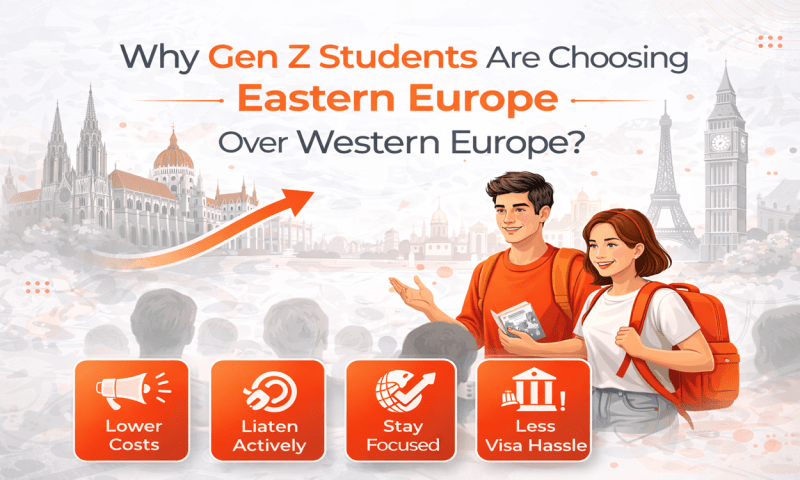
More Gen Z students are shifting their focus from traditional Western European destinations to emerging education hubs in Eastern Europe. This blog explores why Gen Z students are choosing Eastern Europe over Western Europe, highlighting affordable tuition, lower living costs, English-taught programs, strong STEM courses, and growing job opportunities. Discover how countries like Poland, Hungary, Romania, and Lithuania are becoming attractive alternatives for international students.
Table Of Contents
Why Gen Z Students Are Choosing Eastern Europe Over Western Europe?
Why Gen Z students are choosing Eastern Europe over Western Europe. Discover affordable tuition, lower costs, and growing study opportunities.
Keywords: Why Gen Z students are choosing Eastern Europe, study in Eastern Europe, Eastern Europe vs Western Europe study, affordable universities in Eastern Europe, Gen Z study abroad trends, low-cost study destinations Europe, international students in Eastern Europe
The map of global student mobility is shifting. For decades, Western Europe (the UK, France, the Netherlands, Germany, and the Nordic countries) was the obvious European choice for international students. Over the last few years, however, a new current has emerged: Gen Z — pragmatic, cost-aware, digitally native, and experience-hungry is increasingly looking east. Eastern European countries such as Poland, the Czech Republic, Hungary, Romania, Croatia, and others are no longer “backup” options. They are front-of-mind destinations for a generation choosing value, culture, and career pathways, not just brand-name degrees.
The section below covers the practical pull reasons, the cultural and lifestyle appeal, the practical compromises, and the things Gen Z students should think about while deciding between East and West for their higher education.
What the numbers and headlines are saying about Gen Z students are choosing Eastern Europe over Western Europe?
These recent statistics and news stories highlight the patterns and show how Gen Z (international students) are choosing more economical and alternative locations, such as Eastern Europe. Many of the statistics and qualitative conclusions are pertinent, even if not all sources clearly distinguish between Eastern and Western Europe. Moreover, several official and media sources report steady growth in international enrollment in Eastern Europe. For example, Poland recorded over 100,000 international students in the 2024/25 academic year, reflecting consistent increases over recent years.
Key statistics and surveys
- EU Foreign Student Share-
- This gives a sense of how internationalization is significant in Europe in general.
- Some Eastern European countries have very high internal (within-Europe) mobility, which shows that Europe is already a central “exporter/receiving” region.
- Student Preferences and Motivations (Gen Z)-
- A survey by INTO University Partnerships found that among Indian Gen Z students aiming to study abroad, 76% plan to work and settle abroad after completing their degree.
- One-third of them consider post-study work opportunities and the quality of education as key factors in destination choice.
- Another survey (INTO 2021) of ~1,200 Gen Z students from 93 countries found that 72% said that the “ability of a university to give them the skills they need to succeed in the future” (i.e., outcomes) is more important than rankings.
- Shifts in Indian Student Interests-
- Enquiries from India for overseas study rose by 37% in 2025, per Rostrum Education.
- In that same context, students are increasingly open to “new” destinations (beyond traditional ones), driven by cost, visa, and employment concerns.
- Employment Rates of Eastern European Students Studying in Western Countries
- In England and Wales, international students from Eastern Europe have some of the highest employment rates among non-UK-born students. For example, ~73.9% of Romanian students and ~62.3% of Bulgarian students in England/Wales were in employment (some alongside studies).
- This suggests that strong “earn-while-studying” or part-time work opportunities are being utilized.
- Growth of Alternatives & Perception Shifts
- Business schools in Eastern Europe & in India are gaining ground among Indian students as Western destinations become more expensive / harder to access.
- More students are factoring in quality + cost + post-study work rather than purely prestige.
- Course Motives and What’s Important
- In surveys, many prospective students say they'd still study abroad even if similar quality were available nearer home, provided factors like cost and opportunity were favorable. (E.g., 41% in one Indian Gen Z survey.)
- Sustainability, inclusion, and “real-world outcomes” are increasingly important.
In 2023, 8.4% of tertiary students in the EU were from abroad.
What are the reasons for moving Gen Z students toward Eastern Europe over Western Europe?
1) Affordability: tuition and living costs matter more than ever-
Gen Z grew up amid rising tuition, ballooning living expenses, and the 2008–2020 era of mounting household debt. That experience makes them pragmatic buyers of education: they’re comparing monthly budgets and ROI, not just university logos.
- Lower tuition or competitive fees. Many Eastern European public universities charge modest tuition for international students compared with private institutions in the West or Anglophone countries. Even when fees exist, they’re often a fraction of comparable Western programs — especially for medicine, dentistry, and business programs that can be eye-wateringly expensive elsewhere.
- Lower cost of living. Cities like Warsaw, Kraków, Prague, and Budapest are typically significantly cheaper than major Western European cities. Cost-of-living comparisons show that, for example, Warsaw’s cost of living is notably lower than Berlin’s; students can often stretch their monthly budgets further in Eastern capitals and university towns. That difference matters for rent, food, transport, social life, and unpaid internships.
However, many prospective students pay a large share of their study costs themselves, such as doing part-time jobs, making family contributions, or saving money. Lower monthly expenses translate into less debt, more time for internships, or the ability to pursue unpaid extracurriculars that improve employability.
2) More English-taught programs, the language barrier is shrinking-
Ten years ago, language was the biggest obstacle to studying in Eastern Europe. Today, that’s much less true. Universities across the region have rapidly expanded English-taught bachelor’s and master’s programs to attract international applicants. This has been a deliberate response to global demand and is visible across STEM, business, medical, and humanities programs.
For Gen Z, who are globally mobile and comfortable with English as an academic lingua franca, the increase in English offerings means they can access high-quality programs without months or years of language study. It also loosens the “Western Europe only” mindset: you can study in Prague, Budapest, or Warsaw in English and still get an internationally relevant degree.
3) Quality + reputation: rankings are changing, and practical credentials count-
One of the old objections to Eastern Europe was “the quality of education.” That generalization is outdated.
- Several Eastern European universities are climbing international rankings and research networks; many are members of pan-European alliances, participate in Erasmus+, and run joint degrees and research projects with Western institutions.
- Eastern European graduates are highly employable in disciplines like software engineering, data science, medicine, and life sciences — partly because curricula emphasize strong technical fundamentals and partly because local industries and startups have matured.
Gen Z tends to value real-world skills, internships, and hands-on learning. Suppose a university in Eastern Europe offers practical labs, industry partnerships, and an internship pipeline. Many students will prefer that over a Western program with a “prestige” name but less clear career pathways.
4) Career pathways: internships, tech hubs, and return-on-investment-
A degree is an investment. Gen Z evaluates education in terms of near-term employability and longer-term mobility.
- Local tech and startup scenes are growing. Cities such as Kraków, Warsaw, Prague, and Budapest host thriving tech ecosystems, outsourced R&D operations, and multinational offices that hire locally. Students can intern in these hubs, build portfolios, and often find graduate roles — sometimes for much lower competition than in mega-markets like London or Paris.
- Regional mobility inside the EU. Several Eastern European countries are in the EU or Schengen area, allowing for easier travel and, in some cases, work mobility post-study for EU citizens. Non-EU international graduates face varying post-study work options; some countries have clearer paths than others, so it’s essential to check country-specific immigration rules. For example, Poland’s system does not have a federalized “post-study work visa” like some Anglophone countries; graduates often navigate temporary residence permits, employer sponsorship, or other national pathways.
5) Visa policy and bureaucracy: simpler in many places-
Visa rules and immigration pathways are critical factors in destination choice. Over the last few years, some Anglophone destinations tightened post-study or skilled migration channels, while several European countries streamlined student visa processes and enrollment requirements to attract talent.
Eastern European countries vary widely. Some have student-friendly application processes and straightforward residence permits for study, while others are more complex. The point is that, in the aggregate, the region is actively competing for international students and reducing unnecessary hurdles (scholarships, clear admission pages, welcoming offices). That makes application cycles less intimidating for first-time international applicants.
6) Cultural, social, and lifestyle appeal: authenticity over gloss-
Gen Z prizes authenticity. For many students, the allure of Eastern Europe is cultural richness held at student-friendly prices.
- Historic city centers, festivals, vibrant café and music culture, and a lively student social calendar make cities like Kraków, Prague, and Budapest social hotspots. Still, without the same tourist markup you’d see in Paris, Amsterdam, or London.
- Eastern Europe often offers a “European” experience (architecture, museums, access to Western Europe) at a fraction of the cost.
- For creative students (film, art, game design), the region’s lower production costs make it easier to build portfolios, run indie projects, and collaborate with other students.
However, Gen Z often prioritizes hands-on experiences: weekend trips, student clubs, cultural immersion, and the ability to pursue side projects without draining savings. Eastern Europe usually makes that lifestyle accessible.
7) Safety, healthcare, and student support: improving infrastructure-
Concerns about safety, healthcare access, and student well-being used to be a barrier. Those concerns are fading as universities and local governments invest in international offices, counselling services, scholarship support, and integration programs.
Many universities have dedicated “Welcome” units, international student advisors, and mental health resources, factors that matter to families and to Generation Z, which places higher emphasis on well-being and community support than earlier cohorts.
8) Scholarships, international cooperation, and government initiatives-
A number of Eastern European countries actively recruit students through scholarships (bilateral agreements, government-funded scholarships like Stipendium Hungaricum in Hungary, national grants, and university-level bursaries). These programs reduce the net cost and make high-value programs accessible to broader applicant pools.
Scholarships, incoming Erasmus+ mobility, and university partnerships are practical draws: they offer tangible reductions in cost and risk and clear routes to mobility within Europe.
9) Digital native students value hybrid and flexible learning-
Gen Z expects flexible study modes. Many Eastern European universities adapted quickly during the pandemic to provide hybrid learning, online resources, and international collaborations. For students who value a mix of in-person campus life and digital study flexibility (interning remotely, freelancing, or taking gig work), Eastern Europe can offer a lower-cost base with the digital infrastructure to support remote opportunities.
Explore more | Germany’s Skilled Migration Act 2026: Pathways from Study to PR | Student Visa Interview Questions and Answers | Hidden Costs of Studying Abroad in Europe
Which Eastern European countries are highlighted as popular study destinations for Gen Z students?
Here’s a concise primer on several popular Eastern European destinations so you can see the differences at a glance.
Poland (Warsaw, Kraków, Gdańsk)-
- Large and growing international student population (over 100,000 international students in 2024/25).
- Affordable living in most cities; strong medical, engineering, and business programs; active tech sectors in several cities. Visa and post-study work pathways exist but require attention to national rules.
Czechia (Prague, Brno)-
- With strong technical universities and well-known humanities programs, Prague is a primary cultural magnet. There are plenty of English-taught master’s degrees and an active student life.
Hungary (Budapest)-
- Budapest offers a vibrant international student community, scholarship programs (e.g., Stipendium Hungaricum), and strong English-language programs in medicine, IT, and business.
Romania, Bulgaria, Croatia-
- Competitive tuition, low living costs, and fast-growing program offerings for international students, often with modernized curricula and increasing English-medium teaching.
What key trade-offs and challenges should international students carefully consider before choosing to study in Eastern Europe?
No destination is perfect. Eastern Europe has trade-offs that matter depending on your priorities.
- Recognition and reputation nuances. A degree from a lesser-known Eastern European institution may require extra explanation from employers in some markets, such as research program accreditation and professional recognition (especially for fields like medicine, law, and engineering).
- Language for local internships. While studies may be in English, many local internships or part-time jobs will require at least some local language. Learning basic local language phrases will pay off.
- Varied post-study immigration rules. If your goal is long-term work or migration, inspect national immigration policies closely, as they differ widely between countries. Poland, for instance, doesn’t operate a standardized “post-study work visa” in the same way some Anglophone countries do; you’ll need to plan for temporary residence permits or employer-sponsored visas as applicable.
- Perceptions among employers. In some career paths (especially those heavily brand-driven), degrees from Ivy League, Russell Group, or elite Western European schools still carry weight. If employer brand is your top metric, align your choice accordingly.
What essential steps should Gen Z students follow when preparing to study in Eastern Europe?
Here is a practical checklist to assess Eastern European programs if you are a Gen Z applicant-
- Program fit: Does the curriculum match your career goals? Are there practical placements and internship opportunities?
- Language & instruction: Is the program taught in English? What language skills are needed for internships or daily life?
- Accreditation & recognition: Is the degree recognized in countries where you want to work? Check professional accreditation where relevant (medicine, engineering, law).
- Cost estimate: Build a realistic monthly budget (rent, utilities, food, transport, health insurance) and compare it with Western alternatives.
- Scholarships & funding: Are there national or university scholarships? Check deadlines and eligibility.
- Visa & post-study options: Read official immigration pages (the university's international office can help) to understand residence permits and work options.
- Student support services: Does the university have a dedicated international student office, accommodation support, counselling, and career services?
- Career pipeline: Which local or regional companies hire graduates? Are there university job fairs or industry linkages?
- Lifestyle & culture: Visit online student forums, Instagram accounts, and YouTube vlogs to get a feel for day-to-day life.
- Backup plan: If you plan to move to Western Europe or elsewhere after graduation, map the realistic steps and timelines.
How Gen Z decision-making differs (and why Eastern Europe fits)?
Gen Z’s approach to choosing where to study is noticeably different from that of earlier generations, and these differences make Eastern Europe a natural fit-
1. Value-for-money mindset- Gen Z grew up during a time of rising tuition fees and global economic uncertainty. They evaluate education like an investment: comparing tuition costs, living expenses, and return on investment (ROI).
Moreover, many universities in Poland, Czechia, Hungary, and other Eastern European countries offer internationally recognized degrees at a fraction of the cost of Western Europe.
2. Outcome-focused rather than prestige-driven- Instead of chasing only big-name universities, Gen Z prioritizes practical skills, internships, and employability after graduation.
Eastern European universities often emphasize hands-on training, industry partnerships, and strong technical programs, which are attributes that match Gen Z’s career-oriented goals.
3. Experience and lifestyle seekers—This generation values authentic cultural experiences, diverse travel opportunities, and an affordable, vibrant social life.
For example, Historic cities like Prague, Kraków, and Budapest provide rich culture and student-friendly living costs, allowing students to explore without breaking their budget.
4. Digitally informed decision-makers- Gen Z relies on online reviews, forums, and virtual campus tours to research options and compare destinations.
However, Eastern European universities' growing visibility online—through English-language websites, virtual open days, and alumni networks—makes them easy to discover and evaluate.
5. Risk-calculated mobility- Rather than simply following traditional routes, Gen Z is willing to explore less conventional destinations if they offer clear benefits and manageable risks.
Moreover,affordable education, growing job markets, and EU travel opportunities provide a balanced mix of adventure and security.
Conclusion-
Gen Z students are reshaping global study-abroad trends by prioritizing value, career outcomes, and authentic cultural experiences over traditional prestige. Eastern Europe perfectly matches these priorities, offering globally recognized degrees at lower costs, vibrant cities rich in history, and strong job prospects in emerging economies. With English-taught programs, expanding scholarship options, and more effortless EU mobility, these countries provide both affordability and opportunity. For a generation that values both financial forethought and adventure, Eastern Europe stands out as an innovative, forward-thinking alternative to Western Europe, blending quality education with an enriching lifestyle and a competitive edge in the global job market.
FAQs on Why Gen Z Students are Choosing Eastern Europe Over Western Europe-
Q1. Why are Gen Z students increasingly choosing Eastern Europe over Western Europe?
Ans—Eastern Europe offers quality education, lower tuition fees, affordable living costs, and strong career opportunities compared to many Western European countries.
Q2. Is the quality of education in Eastern Europe recognized globally?
Ans- Yes. Many universities in countries like Poland, Czechia, and Hungary are internationally accredited, and their degrees are accepted worldwide.
Q3. Are there enough English-taught programs in Eastern Europe?
Ans- Absolutely. Most major universities offer a wide range of undergraduate and postgraduate programs in English.
Q4. How much cheaper is it to study in Eastern Europe?
Ans- Tuition and living expenses can be 30–60% lower than in Western Europe, making it a cost-effective option.
Q5. Do Eastern European countries offer scholarships for international students?
Ans- Yes. Governments and universities provide merit-based and need-based scholarships for international students.
Q6. What career opportunities are available after graduation?
Ans- Graduates can access growing industries like IT, engineering, business, and healthcare, and may qualify for EU-wide job opportunities.
Q7. Is it easy to travel within Europe from Eastern European countries?
Ans- Yes. Many are part of the Schengen Area, allowing students to travel easily across EU member states.
Q8. What is student life and culture like in Eastern Europe?
Ans- Cities like Prague, Kraków, and Budapest offer vibrant student communities, rich history, and affordable entertainment.
Q9. Are visas and post-study work options student-friendly?
Ans- Many Eastern European countries have streamlined visa processes and offer post-study work permits or pathways to residence.
Q10. What should students consider before choosing Eastern Europe?
Ans- They should research the language requirements and local job markets, as well as ensure their chosen university and program are fully accredited.
Published on: 26/2/2026Last updated: 8/5/2026
0 comments
No comments yet. Be the first to comment!