APS Certificate 2026 Update: What Indian Students Must Know
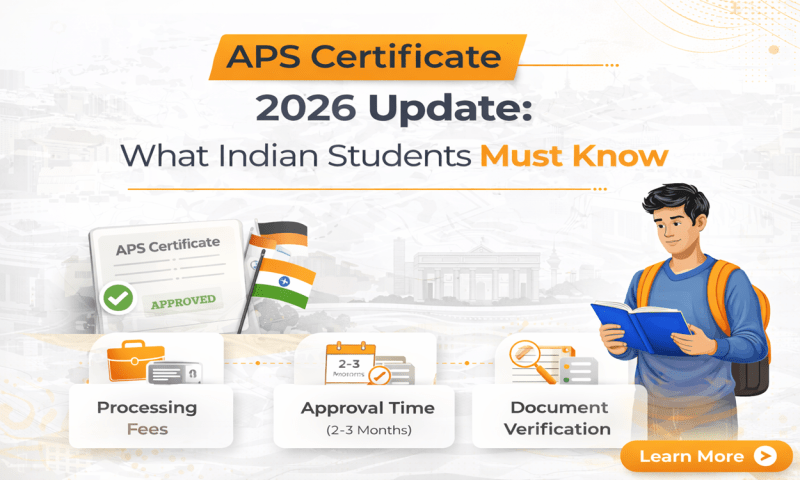
The APS Certificate is a mandatory requirement for Indian students applying to German universities. This blog covers the APS Certificate 2026 update, explaining eligibility, required documents, processing time, fees, and recent changes students must know. Learn how to apply correctly, avoid delays, and ensure your academic documents are verified smoothly before starting your Germany study visa process.
Table Of Contents
APS Certificate 2026 Update: What Indian Students Must Know
APS Certificate 2026 update for Indian students. Learn eligibility, documents, fees, processing time, and key changes for Germany study visa.
Keywords: APS Certificate 2026 update, APS Certificate for Indian students, APS Germany requirements 2026, Germany study visa APS, APS document verification India, how to apply for APS Certificate, APS processing time 2026, Academic Evaluation Centre certificate
The APS certificate is the official document issued by the Academic Evaluation Centre (APS) tied to the German missions that verifies the authenticity and equivalence of Indian academic records for students who want to study at German universities and apply for a long-term student visa. In 2025–2026, the APS India office will continue digital delivery of certificates while tightening submission rules (physical documents must be sent by courier/post only), clarifying TestAS requirements for certain bachelor applicants, and emphasising that processing begins only after physical documents are opened, which affects realistic timelines. If you’re applying in 2026, plan for the APS step early, budget for the official fee, and follow the new submission rules carefully.
Why APS matters?
APS is not optional for most Indian students who intend to pursue degree-level study in Germany (programs longer than 90 days). The German visa authorities and many universities treat an APS certificate as a core verification: it confirms your documents are authentic, shows whether your qualification meets German entry standards, and is required for the student visa dossier in many cases. In short: skip APS and you’ll stall your visa/admission process.
What has been changed for 2025–2026 you must know?
- Courier-only submissions- APS India now accepts documents only via registered post or courier. Personal drop-offs and public office hours are no longer available. This is a persistent change: after online registration, you must send the signed form and hard-copy documents by courier to the APS office in New Delhi. Plan the courier timing and tracking carefully.
- Processing begins after physical opening - APS makes clear that the one-month processing clock starts only after your physical application package has been opened by the office. Administrative backlogs before opening (bank confirmation, queueing) can add days or weeks before verification work begins. Expect some administrative delay between your payment/online submission and actual processing.
- Digital delivery of the certificate-Successful verifications is issued digitally (by email) to applicants. APS India’s practice is to provide a digital APS certificate once verification is complete. Keep the email address on your APS account accurate and monitor spam folders.
- Fee, non-refundability and payment channels- The official APS India fee remains INR 18,000 (non-refundable). It must be paid via the payment options specified on the APS portal (bank transfer or online gateway). Save payment receipts the physical receipt must usually accompany your courier package.
- TestAS requirement flagged for certain bachelor applicants- APS has announced that candidates who have not completed a full Indian bachelor’s degree and are applying for a Bachelor’s in Germany will generally be required to submit a TestAS score, with some exceptions (e.g., JEE qualifiers). APS is monitoring and will announce an official start date for that requirement. If you’re a current undergraduate applying for a bachelor's entry, watch APS news and prepare for TestAS if applicable.
- Higher traffic & occasional delays remain- APS continues to warn of seasonal spikes and higher volumes causing extended timelines beyond the “typical” 3–4-week window. Many third-party reports show students experiencing longer waits in busy admission seasons plan buffer time.
How to get your APS certificate?
- Check whether you need APS-
- APS is required for most Indian students applying to degree-level study in Germany (not required for short language courses or if you already have a non-Indian foreign degree). Use the APS eligibility quiz on the official site to confirm.
- Register online on the APS India portal-
- Create your account, choose the correct procedure (e.g., Bachelor, Master, Exchange), and fill the form carefully. Mistakes in the online form complicate or delay processing.
- Pay the verification fee (INR 18,000)-
- Pay through the APS-specified method (CCAvenue/NEFT/online transfer). The fee is non-refundable. Download and print the payment confirmation/receipt.
- Print, sign and assemble the physical package-
- Print the completed application form, sign it where required, and attach passport photos or other items as requested. Include legible A4 colour photocopies of all documents (both sides), payment receipt, and any required translations (notarized if from a regional language).
- Send by registered courier to APS India (New Delhi)-
- APS requires documents by post/courier. Use a reliable tracked courier service and keep tracking information. APS will not accept personal drop-offs.
- Wait for verification and possible interview-
- APS may call some applicants (especially bachelor applicants) for an interview. Interviews can be in English or German. If invited, APS usually gives 2 weeks’ notice before scheduling. If you are asked to appear, attend as instructed.
- Receive a digital APS certificate by email-
- Once successful, the digital certificate will be emailed to you, and your APS account will be updated. You can use this certificate for university/visa applications as instructed.
Which documents are required to get an APS certificate?
Typical documents which are mandatory are-
- Signed APS application form (printed from your APS account).
- Payment receipt (Approximate-INR 18,000).
- Passport copy (first and last page).
- Class X- and XII-mark sheets and certificates (if applicable).
- Bachelor’s or Master’s transcripts/degree (as applicable). If the degree has not been issued yet, a recent provisional certificate (note APS provisional certificate rules).
- Language certificates (IELTS/TOEFL or German tests) – include if you have them (they become a permanent record on the APS certificate).
- Translations for documents not in English (notarization required if translated from Indian regional languages).
Keep in mind- Always check the APS checklists for your specific procedure on the official site before sending anything.
What about APS Certificate timelines, realistic expectations for 2026?
- APS certification is mandatory for many Indian students whose previous qualification is from India and who want to study in Germany (Bachelor’s, Master’s,) unless exempted.
- The processing time is variable: many sources indicate about 3-4 weeks in ideal cases, but active caution is required, up to 6–8 weeks or more, especially in busy seasons or if additional verification is required.
- The certificate has been issued digitally (PDF) since April 2023.
- APS recommends you complete the APS process before applying to your German university to avoid delays.
Timeline and planning for the 2026 intake
Given the above, here’s a recommended timeline you should aim for, if you’re targeting a 2026 intake:
- As soon as you decide on Germany + university
- Start gathering documents (10th, 12th, degree transcripts, translations if needed, passport copies, etc.)
- Register on the APS India portal and pay the fee.
- Aim for these 4-5 months before your target university’s application deadline.
- Document submission & verification
- Submit your complete APS application.
- Once APS receives a complete application, allow ~4-8 weeks for processing. In peak periods, it might stretch.
- Keep checking your online portal/status. APS may ask for follow-up (missing docs, clarifications).
- Receive APS Certificate
- Once approved, you will be issued a digital PDF certificate via email.
- After that, you can include it in your university applications & visa paperwork.
- Aligning with university deadlines
- Many German universities for the winter semester 2026/27 will have application windows early in the year (e.g., Feb-March) or mid-year for the summer semester. For example, the application period for one program was Feb 1-Mar 1, 2026.
- So, finish your APS by the latest 3-4 months before your university application deadline to avoid last-minute risk.
Realistic expectation for 2026
- If you plan to apply for the winter semester 2026/27 (starting around Oct/Nov 2026), your university application might open in Feb-March 2026 (or earlier).
- Therefore, ideally, your APS application should be submitted by December 2025 – January 2026 at the latest, so you expect the certificate in January-February 2026.
- For the summer semester 2026 (if available), you might aim earlier: submit APS by around September-October 2025 to be safe.
What about the costs you must budget for beyond tuition and living?
For Indian students planning to study in Germany in 2026, budgeting beyond tuition and living expenses (like rent and food) is crucial because there are hidden or often-overlooked costs that can add up. Here’s a complete breakdown of realistic extra costs you should plan for beyond tuition and living expenses, especially when going through the APS Certificate process and moving to Germany.
APS Certificate and Application-Related Costs-
- APS Certificate Fee-
- Fee: ₹18,000 (as of 2025, payable to APS India).
- Mode: Bank transfer only (no UPI or card).
- Note: The fee is non-refundable, even if your documents are incomplete or rejected.
- Always include postal and documentation costs.
- Courier Charges-
- For sending hard copies (if required): ₹300–₹1,000 (depending on service and location).
- International courier for verified documents (rare cases): ₹2,000–₹4,000.
- Translation and Notarization-
- If your documents are in a regional language, they must be translated into English or German by certified translators.
- Translation: ₹500–₹1,500 per page.
- Notarization: ₹100–₹500 per document.
- University Application Fees-
- Public universities in Germany usually don’t charge tuition, but may charge small application/administrative fees:
- UniAssist processing fee: €75 (₹6,500) for the first university + €30 (₹2,600) for each additional one.
- Some universities charge an internal processing fee: €25–€50.
Other realistic cost
- Pre-Departure Expenses- Before moving to Germany, students face several pre-departure expenses beyond tuition. English proficiency tests like IELTS, TOEFL, or PTE cost ₹16,000–₹18,000, while GRE fees can reach ₹24,000. Health checkups range from ₹2,000–₹5,000, and mandatory student health insurance costs €120–€150 (₹11,000–₹13,000) monthly. Visa fees are about €75 (₹6,700) plus ₹2,000–₹3,000 in service charges, while miscellaneous costs such as photos and document attestation add ₹500–₹2,000.
- Travel and Settlement Costs- Travel and settlement expenses include one-way flights to Germany priced at ₹45,000–₹70,000, travel insurance of ₹2,000–₹5,000, and extra baggage fees of ₹5,000–₹10,000. Temporary accommodation for 2–4 weeks costs €25–€50 per night, totalling ₹35,000–₹70,000. Students must also open a mandatory blocked account with €11,208 (₹10.2 lakh) as proof of funds, along with setup fees of €50–€150 and monthly maintenance of €5–€10.
- Blocked Account and Financial Proof- A blocked account is mandatory for a German student visa, requiring a balance of €11,208 per year, equivalent to about ₹10.2 lakh. Although this amount is refundable, it must be deposited in advance. Setup fees range from €50 to €150, with maintenance charges of €5–€10 per month. Students are advised to open their blocked accounts well before their visa appointment to avoid processing delays.
- Post-Arrival and City Registration Costs- Upon arrival, registration may cost up to €10, and the residence permit fee is €100–€110 (₹9,000–₹10,000). A semester contribution of €250–€350 (₹22,000–₹31,000) covers transport and services. Communication expenses include SIM cards (€10–€20) and internet plans (€20–€30).
- Miscellaneous and Contingency Costs- Additional costs include winter clothing (€200–€400 or ₹18,000–₹36,000), books (€50–€100 or ₹4,500–₹9,000), and minor setup expenses under €20. A contingency fund of €500–€1,000 (₹45,000–₹90,000) is advisable for emergencies. Overall, students should budget wisely to ensure a smooth transition to studying in Germany.
What are the common mistakes in getting an APS certificate, and how can they be avoided?
- Sending incomplete packages- Missing signatures, receipts, or unclear photocopies are the top cause of delays or rejections. Use the APS checklist, double-check each item, insert a printed contents list, and photograph the package before sending.
- Submitting unverified academic documents-Unattested or provisional mark sheets often lead to application rejection. Always provide officially issued and attested transcripts or degree certificates from your university registrar.
- Using incorrect payment methods-Transferring fees through non-approved channels or forgetting to attach the transaction proof can stall your application. Follow APS payment instructions carefully and include the receipt with your package.
- Delaying the application process- Starting late means missing German university or visa deadlines. Begin your APS process at least six to eight months before your intended intake to stay ahead of processing delays.
- Forgetting document translations- Submitting mark sheets or degree certificates in regional languages without certified English or German translations causes verification issues. Always include both the original and translated copies.
- Incorrectly labelling documents- Sending papers without your APS number or name can confuse. Label every page clearly and include a cover letter listing all enclosed documents.
- Inconsistent personal details- Variations in name spellings, birth dates, or university records lead to mismatch errors. Ensure all details match your passport exactly before submission.
- Ignoring APS communication- Missing important clarification emails from APS can halt your evaluation. Check your registered email daily and respond promptly to any queries.
- Failing to keep copies- Many students forget to save copies of their documents and payment proof. Always scan and store digital backups of all submitted materials.
- Underestimating the APS process-Treating APS as a mere formality leads to carelessness. Remember, it validates your academic authenticity and is mandatory for German university admission and visa approval.
What to do if your APS application is delayed or rejected?
- First step checks your APS account and email. APS updates the online profile and sends emails when verification is complete or if there’s a problem.
- If documents are incomplete or rejected, APS will explain the reason, and you may need to resubmit. Note that the fee is non-refundable.
- If processing is unusually delayed, check APS news and announcements; sometimes system maintenance or staff shortages cause temporary slowdowns. You can contact APS by the official contact form/email, but expect response delays due to high inquiry volumes. Keep your courier tracking and payment receipts handy to prove submission dates.
- If you must meet a university deadline, communicate with the university’s admissions office (many understand APS delays and may accept conditional steps or issue a later enrolment date). Don’t miss visa appointment slots: if the APS delay would cause a missed visa window, inform your university and VFS/German mission as early as possible.
What about the TestAS change and why it matters?
The TestAS change refers to the revised requirement introduced by the APS (Academic Evaluation Centre) and many German universities, making TestAS (Test for Academic Studies) mandatory for certain applicants from India starting in 2026.
APS’s indication that TestAS may become a formal requirement for certain bachelor-entry applicants is notable. TestAS is an academic aptitude test designed to help German universities assess the readiness of international applicants for undergraduate study. Requiring TestAS for applicants who have not completed a full Indian bachelor’s degree is intended to standardise assessment for those who apply with partial or provisional academic records. If you’re in your undergraduate program and plan to apply to Germany for a Bachelor’s, start preparing for TestAS as a precaution and monitor APS announcements closely.
It matters because TestAS now plays a key role in assessing a student’s academic aptitude and readiness for German higher education. The results help universities compare applicants fairly, especially from countries with varied grading systems like India. A strong TestAS score can enhance admission chances, especially for competitive programs or when academic transcripts alone don’t reflect full potential. In addition, TestAS has become an essential benchmark for Indian students, ensuring academic credibility and transparency in the German admission process.
Digital vs. paper certificates: what to expect?
- Shift to Digital Verification: From 2026, APS is moving toward a digital system, allowing certificates to be verified online through a secure portal.
- Faster and Safer Process: Digital certificates eliminate courier delays, reduce the risk of loss or damage, and ensure quicker verification by universities.
- Greater Security: The digital format minimizes the chances of document forgery or tampering, improving the reliability of academic verification.
- Hybrid Transition Phase: Both digital and paper certificates will be accepted in 2026, as universities gradually adapt to the new system.
- Paper Certificates Still Valid: Traditional paper APS certificates remain valid, especially for institutions or Uni-Assist applications that have not fully adopted digital verification.
- Future Standard: Over time, the digital APS certificate will become the default option for all applicants due to its convenience, global accessibility, and verification speed.
Tips to speed up things
- Start early- Apply to APS before your admission offers and visa window become urgent.
- Follow the official APS checklist exactly- Ticking every box avoids obvious rejections.
- Use a tracked courier and buy insurance- Keep proof of postage and delivery. APS cannot check packages that are delayed in transit.
- Keep digital copies of every document- Upload originals during registration if required, and keep PDFs ready for university/VISA use.
- Attach language certificates if you have them- APS will record them, and this can help with university applications.
- Prepare for a possible interview- Especially bachelor applicants: be ready to explain your course, grades and motivation succinctly in English/German.
What do universities and visa officers look for, and why does the APS certificate matter beyond bureaucracy?
- Authenticity of Academic Records: APS verifies that all submitted degrees, mark sheets, and transcripts are genuine and issued by recognized institutions.
- Academic Equivalence: It confirms that an Indian student’s qualifications meet German academic standards, ensuring eligibility for admission to German universities.
- Verification of Course Duration and Content: APS checks whether the completed coursework aligns with German higher education structures, helping universities assess subject compatibility.
- Consistency in Academic History: Any gaps, inconsistencies, or mismatched information in transcripts are reviewed to maintain transparency and credibility.
- Fair Admission Evaluation: By standardizing document verification, APS allows German universities to compare international applicants from different education systems fairly.
- Confidence for Visa Approval: A verified APS certificate signals to visa officers that the student’s academic background is legitimate, reducing the chances of fraud or document-related visa rejections.
- Faster Application Processing: Since documents are pre-verified by APS, universities and embassies can process applications more efficiently, minimizing delays.
- Proof of Academic Preparedness: Beyond paperwork, the APS certificate reflects a student’s readiness and seriousness about studying in Germany, strengthening their overall profile.
When APS says “you’re exempt”, what are the common exemptions?
You may not need an APS certificate if:
- Your highest degree is an international secondary school leaving certificate (e.g., IB), and you’re applying for a Bachelor's.
- You already hold a non-Indian foreign degree (e.g., a UK degree) as your highest qualification.
- You will obtain a stipend from public funds, or you are a recipient of German/EU-funded scholarships (these cases often undergo separate vetting).
- Your PhD/PostDoc application is to a university that explicitly does not require APS verification.
Explore More: Germany’s Skilled Migration Act 2026: Pathways from Study to PR | Student Visa Interview Questions and Answers
Final thoughts
The APS Certificate 2026 update marks a significant step toward a more transparent, digital, and standardized verification process for Indian students aspiring to study in Germany. With changes such as the inclusion of TestAS requirements, gradual adoption of digital certificates, and stricter documentation norms, APS now plays a more central role in ensuring academic credibility and smoother visa processing. While the process may seem demanding, understanding timelines, budgeting for hidden costs, and avoiding common mistakes can make it straightforward. For students serious about German education, the APS certificate is not just a formality—it’s a gateway to trust, academic recognition, and eligibility in one of the world’s most respected higher education systems.
FAQs
Q1. What is the APS Certificate?
Ans- The APS Certificate verifies the authenticity and academic equivalence of Indian qualifications for admission to German universities.
Q2. Why is the APS Certificate mandatory for Indian students?
Ans- It ensures that your academic records meet German standards and speeds up both university admission and visa approval.
Q3. What’s new in the 2026 APS update?
Ans- The 2026 update introduces digital certificates, a TestAS requirement for some applicants, and more apparent document verification timelines.
Q4. Who needs an APS Certificate?
Ans- All Indian students applying for Bachelor’s or Master’s programs in Germany generally need it, unless they fall under an exemption.
Q5. Who is exempt from APS verification?
Ans- Students with German degrees, DAAD/Erasmus scholarships, EU degrees, or international school certificates (like IB or A-Levels) may be exempt.
Q6. How long does APS processing take in 2026?
Ans- Expect 8–12 weeks for complete applications, though delays are common during peak admission seasons.
Q7. What is the APS Certificate fee for Indian students?
Ans- The fee remains ₹18,000, payable via bank transfer only.
Q8. Is the APS Certificate digital or paper-based now?
Ans- In 2026, APS is transitioning to digital certificates, though paper versions are still valid during the transition phase.
Q9. What common mistakes should be avoided in the APS process?
Ans- Incomplete documents, missing signatures, unclear photocopies, and incorrect payment details cause most delays or rejections.
Q10. Why does the APS Certificate matter beyond bureaucracy?
Ans- It assures universities and visa officers that your academic records are authentic, verified, and aligned with German educational standards.
Published on: 25/2/2026Last updated: 8/5/2026
0 comments
No comments yet. Be the first to comment!